The open frontier · 31 July 2026
7 min read · Essay
On 27 July 2026, a page appeared on Hugging Face carrying the weights of Kimi K3. To most people, it looked like another large download on another technical website. To the AI industry, it felt like a locked door had opened.
Behind that door was a model close to the best proprietary systems in the world—and now it could be studied, adapted and operated outside the company that created it. That is why Kimi K3 is not merely a new chatbot. It is a market event, a creative opportunity and a security question arriving on the same day.
The release that made people stop and look
Moonshot AI first released Kimi K3 through its website and API on 16 July. It promised that the model weights would follow eleven days later. The promise mattered because an API gives people access to a service, while weights give capable teams access to the model itself.
The reaction began before the weights arrived. Developers compared its coding and design work. Analysts compared its price with American models. Within days, demand pushed Moonshot close to the limits of its computing capacity. The company temporarily paused new subscriptions and said K3 had received far more interest than expected.
That shortage told a simple story. People were not curious only because K3 was Chinese or because it carried the enormous number of 2.8 trillion parameters. They wanted to know whether a model outside the familiar closed platforms could now do frontier-level work.
A new name at the proprietary table
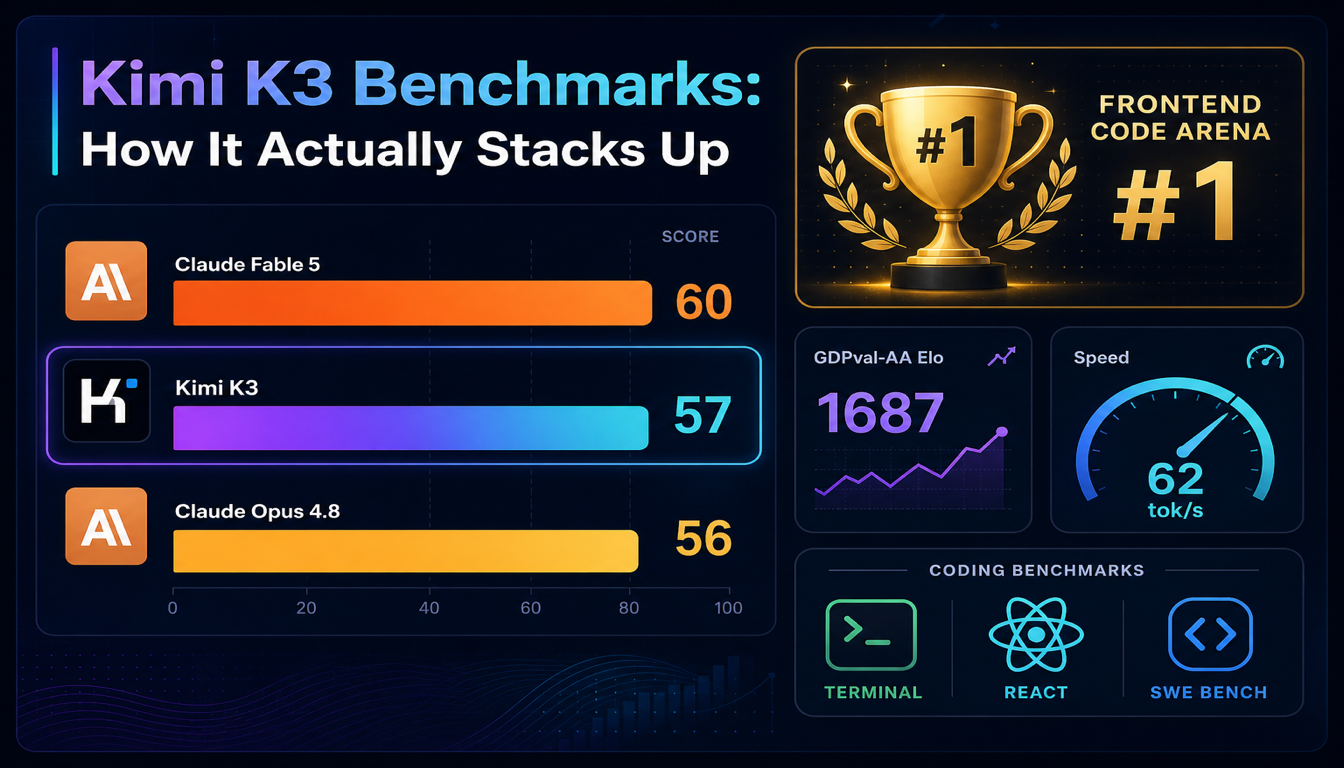
Independent results gave the excitement some substance. At launch, Artificial Analysis scored Claude Fable 5 at 60, GPT‑5.6 Sol at 59, Kimi K3 at 57 and Claude Opus 4.8 at 56 on its Intelligence Index. K3 did not defeat every proprietary model. It did something more important: it entered the same conversation.
Moonshot’s own demonstrations went further. The company showed K3 working on long coding sessions, research, presentations, dashboards, video editing and scientific tasks. These are company demonstrations, not guarantees. But together with third-party rankings, they changed the question from “Is open AI catching up?” to “How quickly will the gap keep closing?”
What one person can achieve now
A student in Chennai does not need a data centre to benefit from K3. A freelance developer does not need to download the full model. Hosted access means an individual can use this level of intelligence like rented machinery: pay for the work performed, learn what it can do, and build without owning the factory that powers it.
One person can now attempt work that once demanded a small team. A developer can ask an agent to understand a large codebase, build a working interface, test it and explain what changed. A researcher can place long documents, spreadsheets and images into one investigation. A designer can move from a rough idea to a website, presentation or visual prototype. A founder can turn customer conversations into proposals, follow-ups and operating documents.
The important word is attempt. K3 can increase reach, not remove judgment. A single person may produce the first 80 percent faster, but the final 20 percent—truth, taste, responsibility and context—still belongs to the human.
What an organization can build
For an organization, open weights create a different possibility. A company with the required infrastructure can operate the model within its own environment, adapt it for internal work and reduce dependence on a single external provider. Others can simply use hosted K3 while keeping their software ready to switch between models.
Imagine a manufacturing company with years of quotations, maintenance reports, quality records and machine manuals. An AI system could search that history, prepare a first quotation, compare a new fault with earlier breakdowns, or turn inspection notes into a customer report. A hospital could build a private document assistant. A university could create a research companion across thousands of papers. A software company could give every engineer a patient code reviewer that understands the whole repository.
None of these benefits require K3 to be “the best model in the world.” They require it to be good enough, affordable enough and controllable enough for a real process. That is the market impact of a credible open-weight frontier model: buyers gain another choice, providers lose some pricing power, and smaller organizations gain room to negotiate.
The market heard a warning
K3 arrived during an already intense contest between the United States and China. Reuters described Chinese developers as closing the performance gap while releasing powerful models at sharply lower cost. The Associated Press reported pressure on American technology shares as investors considered whether more affordable Chinese systems could weaken the pricing power of U.S. AI companies.
The political reaction was just as strong. In Washington, K3 became evidence for two opposite arguments. One side said the United States must move faster and regulate less because open models elsewhere will not wait. The other side saw the same release as proof that frontier systems need stronger independent testing before their capabilities spread beyond any company’s control.
Both reactions come from the same fact: a closed API can change its rules tomorrow. Downloaded weights cannot easily be recalled.
The same open door can be used with bad intent
The benefits are real, and so is the danger. A capable model can help a small business write better proposals. The same capability can help a fraudster create convincing messages at scale. It can help a security team study vulnerable software. It can also help an attacker search for weaknesses. It can translate education into many languages, or manufacture propaganda for many audiences.
A preliminary joint evaluation by the UK AI Security Institute and the U.S. Center for AI Standards and Innovation found that K3 remained below the leading closed models on cyber capability. That is reassuring only up to a point. The evaluators also reported that K3’s safeguards did not stop it from attempting exploit development and offensive cyber tasks. In one of ten trials, it completed a simulated attack on a deliberately weak enterprise network. The test was artificial and had no active defenders, but the signal should not be ignored.
This does not mean open models should be feared or banned. It means access must be matched with responsibility. An organization should know who can use the model, what tools it can touch, what data it can see and which actions still require a person. An individual should not give any AI unchecked control over money, identity, customer communication or irreversible decisions.
The real impact is freedom to choose
Kimi K3 will not end Claude, ChatGPT or the next proprietary model. Closed systems will continue to lead in some areas and may offer a smoother, safer experience. Open models will continue to close gaps, reduce costs and give builders more control. The lead will move back and forth.
What changed on 27 July was the balance of power. An individual gained access to another frontier-grade tool. An organization gained a stronger alternative. A researcher gained weights to study. A competitor gained a benchmark to beat. And a bad actor gained some of the same leverage.
That is the Kimi K3 story. Not 2.8 trillion parameters. Not another leaderboard victory. A powerful door opened. What we build through it—and what we prevent from coming through it—now matters more than the model’s name.
Sources:
Moonshot’s Kimi K3 release ·
Kimi K3 model card and weights ·
Artificial Analysis comparison ·
Associated Press market report ·
Reuters release report ·
UK AISI / CAISI cyber assessment.