Blog
GPT-5.5: Where It Stands in the AI Model Landscape
Introduction
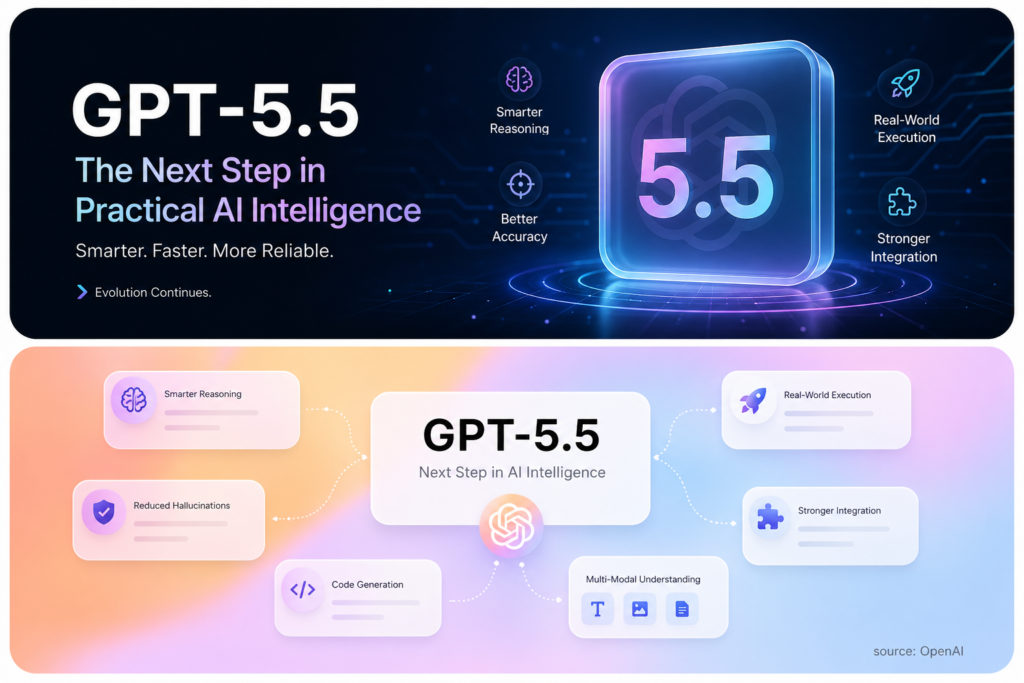
With the rapid evolution of large language models, the question is no longer which model is powerful — but which model is best for what task. From GPT-4 to GPT-5 and now GPT-5.5, alongside competitors like Claude Sonnet and Claude Opus, the ecosystem has matured into a multi-model landscape, each optimized for different use cases. GPT-5.5 does not exist in isolation — it sits at the intersection of speed, reasoning, and execution.
Evolution of the GPT Series
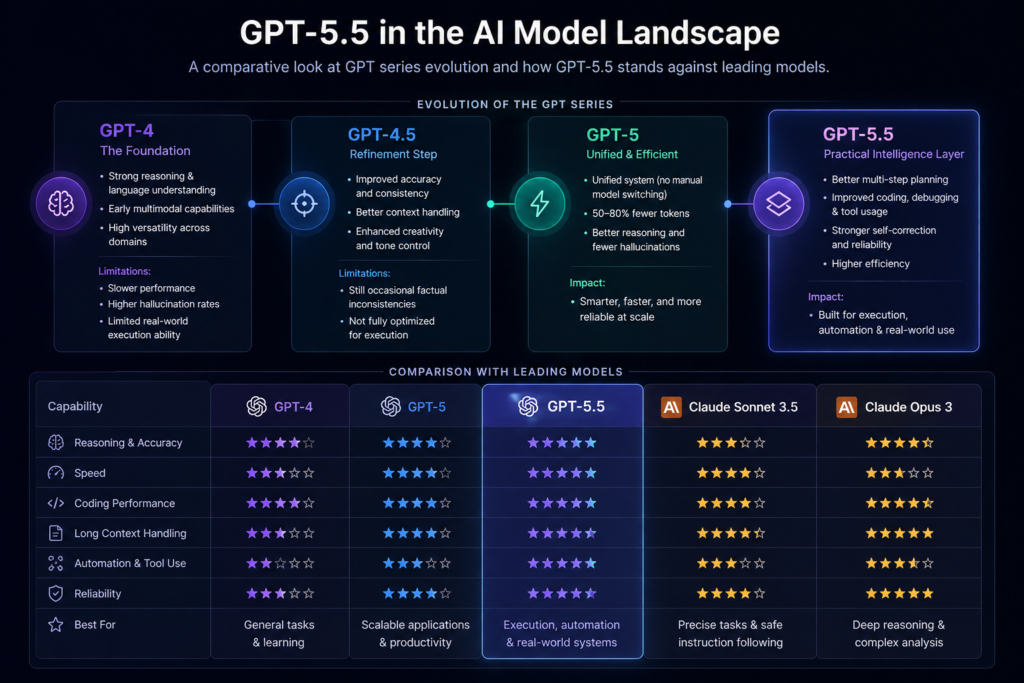
GPT-4 → Foundation of General Intelligence
- Strong reasoning and language understanding
- High versatility across domains
- Early multimodal capabilities
Limitations: Slower performance, higher hallucinations, limited execution ability.
GPT-5 → Unified & More Efficient
- Unified system (no model switching)
- Faster responses and better optimization
- Reduced hallucinations
Impact: Made AI usable at scale
GPT-5.5 → Practical Intelligence Layer
- Improved multi-step reasoning
- Better coding and debugging
- Stronger reliability and consistency
- More efficient task execution
Impact: Built for automation and real-world systems
Comparison with Other Leading Models
Comparison with Leading Models
Claude Sonnet
- High precision and instruction-following
- Best for controlled, smaller tasks
👉 Position: Precision-focused model
Claude Opus
- Deep reasoning and long-context understanding
- Strong in complex analysis and research tasks
👉 Position: Depth-focused model
GPT-5.5 in Context
- Balanced reasoning + speed
- Strong execution and workflow handling
- Better suited for building systems
👉 Position: Execution-focused model
Full Model Comparison Overview
| Category | GPT-5.5 | GPT-5 | GPT-4 | Claude Sonnet | Claude Opus |
|---|---|---|---|---|---|
| Reasoning | More consistent | Stronger | Strong | High precision | Deep & rigorous |
| Speed | Faster | Fast | Moderate | Fast | Moderate |
| Coding | Excellent | Very strong | Good | Precise edits | Best-in-class |
| Long Context | Strong | Improved | Limited | Strong | Excellent |
| Automation | High | Medium | Low | Medium | High |
| Reliability | High | Improved | Moderate | High | Very high |
| Best Use | Execution systems | Scalable apps | General AI | Safe tasks | Complex reasoning |
What This Means in Practice
Use GPT-5.5 if you need:
- End-to-end workflows
- Automation systems
- Real-world applications
- Faster execution with good reasoning
Use Claude Sonnet if you need:
- Controlled outputs
- Safe, predictable edits
- Lightweight tasks
Use Claude Opus if you need:
- Deep research-level reasoning
- Long document analysis
- Complex multi-agent systems.
Conclusion
GPT-5.5 does not dominate by being the smartest model. It stands out because it is the most usable model across real-world scenarios. The industry is no longer competing on intelligence alone it is competing on who can turn intelligence into action.
And that’s exactly where GPT-5.5 positions itself.