From Tamil Nadu for a brighter tomorrow
MissionPhysical AITamil Nadu
Skilling Tamil Nadu for the Physical AI era.
A proposed 2027–2031 mission to connect Tamil Nadu's manufacturing heritage, engineering talent and artificial intelligence ecosystem—and build the people, robots and companies that can power India's next industrial transformation.
Market figures: IFR World Robotics 2026. Tamil Nadu industrial figures: Guidance Tamil Nadu.
The next industrial revolution will move
AI learned to think.
Now it is learning to act.
For the last decade, artificial intelligence has largely existed inside computers. The next wave will operate in factories, farms, hospitals, warehouses, ports, infrastructure and public services.
Physical AI brings together robotics, perception, foundation models, simulation and adaptive control—creating machines that can understand their environment and perform useful work in the real world.
India should not only use the machines of the future. India should build them.
Why we must begin now
The opportunity is larger than robot adoption.
The countries that manufacture intelligent machines will capture value across motors, actuators, electronics, sensors, batteries, embedded intelligence, simulation, safety, software, deployment and service.
Build, not only buy
Growing Indian demand can support locally designed robots, components and intellectual property instead of deepening long-term import dependence.
Move before supply chains settle
The global Physical AI ecosystem is forming now. Waiting risks leaving India as a large customer after production networks have consolidated elsewhere.
Upgrade existing industry
Robotics creates a higher-value market for firms already producing motors, electronics, castings, machining, batteries, wiring and industrial software.
Create strategic capability
The same technologies strengthen EVs, aerospace, healthcare, logistics, infrastructure, defence and advanced manufacturing.
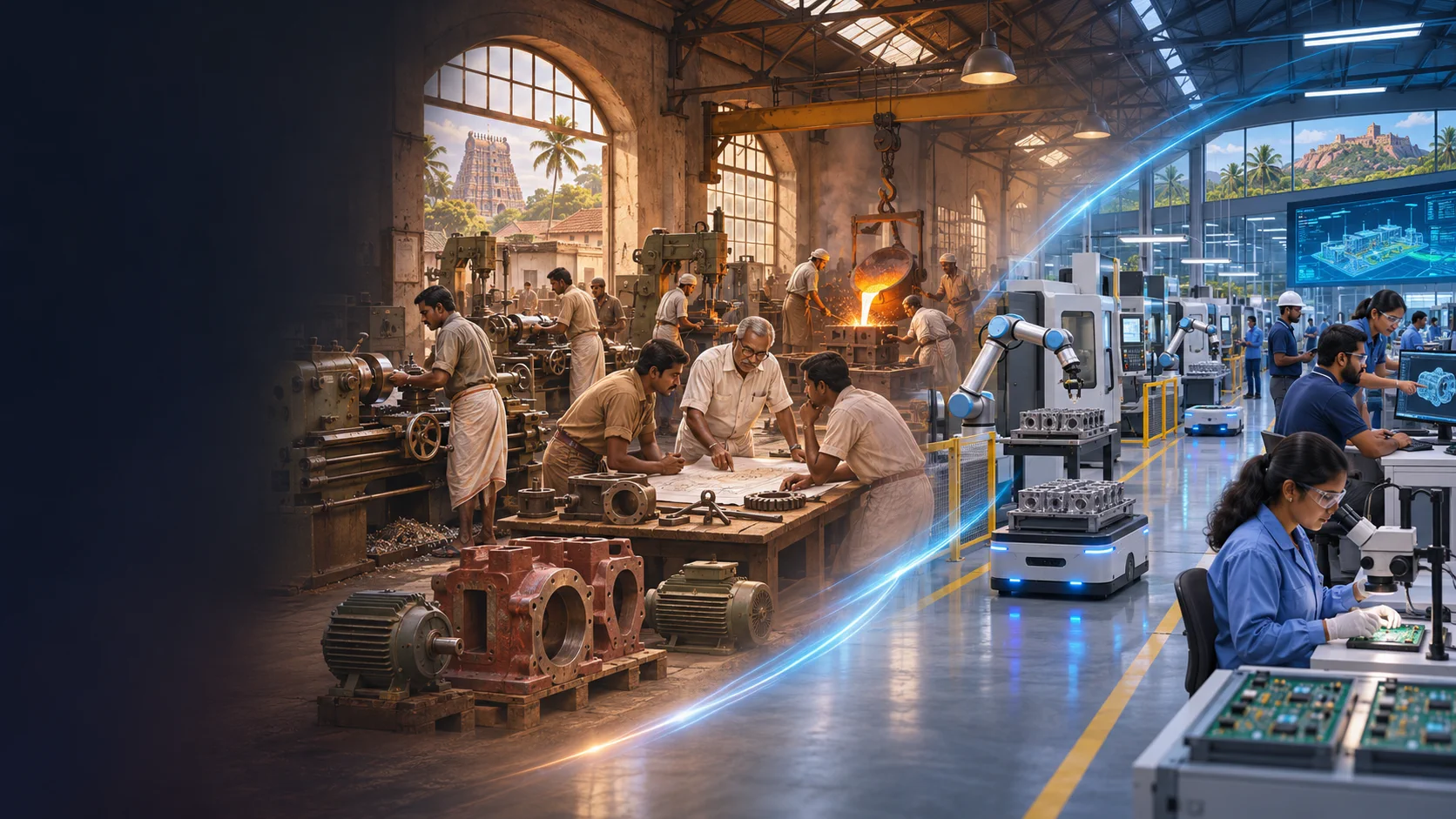
Built by generations. Ready for the next one.
From manufacturing heritage
to intelligent machines.
Tamil Nadu's industrial story was built through workshops, foundries, machine tools, automotive plants and electronics facilities. Physical AI does not replace that history. It builds upon it.
- The machinist becomes a robotics-production specialist.
- The component manufacturer becomes an actuator supplier.
- The software engineer develops intelligence for machines.
- The student becomes a robot builder.
The Tamil Nadu Physical AI Corridor
One connected manufacturing network.
The mission should operate as a network, not a disconnected technology park. A shared Physical AI Factory can connect established industrial clusters through testing, simulation, certification, training and prototype-to-production capability.
Manufacturing hubs
Shared mission infrastructure
Chennai–Sriperumbudur–Oragadam
Automotive, electronics, engineering talent, industrial customers, logistics and export access.
Hosur–Krishnagiri
Advanced manufacturing, automotive and EV supply chains, industrial systems and technology access.
Coimbatore
Precision engineering, motors, pumps, machine tools, foundries and manufacturing entrepreneurship.
Southern industrial corridors
Emerging manufacturing, logistics, renewable energy and distributed supplier-development opportunities.
The proposed Physical AI Factory
Where prototypes become products.
This is not a Government-owned robot assembly plant or a technology-showcase building. It is proposed as common industrial infrastructure where companies can manufacture, test, validate and prepare intelligent machines for deployment and export.
Robot manufacturing & integration
Flexible assembly, wiring, calibration, traceability and end-of-line testing.
Actuator & mechatronics lab
Motors, drives, reducers, joints, encoders and endurance testing.
Electronics & edge AI lab
Controllers, sensors, compute, BMS, power electronics and pre-compliance.
Physical AI data factory
Robot data, teleoperation, synthetic data, evaluation and governance.
Simulation & digital twins
ROS 2, virtual commissioning, HIL and reinforcement-learning workflows.
Safety & certification
Reliability, functional safety, cybersecurity and standards readiness.
Deployment test arenas
Repeatable factory, warehouse, inspection, hospital and outdoor trials.
Supplier development
DFM, quality systems, tooling, localisation and MSME qualification.
Training & production academy
Factory-linked technician, integrator and robotics-production programmes.
People first
A robotics mission must also be a human mission.
Infrastructure alone will not create an industry. Tamil Nadu needs technicians, production engineers, integrators, safety specialists, embedded developers, AI engineers and entrepreneurs who can build and deploy reliable machines.
Learn→Build→Test→Deploy→Manufacture
2027–2031 roadmap
Start lean. Prove demand. Scale with evidence.
Funding and capacity should advance only when each stage demonstrates users, utilisation, private investment, local value addition and a credible path to production or export.
Phase 0
Validate before committing major capital.
- Demand and supplier mapping
- Anchor-user commitments
- Site and capex shortlist
- Standards and operating model
Phase 1
Launch the minimum viable Physical AI Factory.
- Integration and assembly
- Test arena and metrology
- Simulation and data stack
- First paid industrial pilots
Phase 2
Convert Tamil Nadu capability into robot components.
- Actuator and electronics labs
- Vendor qualification
- Design-for-manufacture support
- Local bill-of-material targets
Phase 3
Build throughput, certification and export channels.
- Dedicated production cells
- Export certification
- Global OEM and JV attraction
- Repeat commercial deployments
Phase 4
Grow a self-sustaining robotics cluster.
- Satellite facilities
- Advanced embodied-AI programmes
- Supplier expansion
- Global customer base
Proposed 2031 outcomes
Build an industry—not merely a facility.
The figures below are mission targets for DPR validation, not guaranteed forecasts. Each must be tested against customers, investors, product economics and a bottom-up manufacturing model.
State catalytic programme₹200–325 Crstage-gated · excluding land
→
Private / JV capital target₹800–1,300 Crminimum 4× leverage ambition
→
Annual cluster output₹2,000–3,500 Crmanufacturing + systems + services
The first decision
A focused 90-day feasibility programme.
Approve evidence-gathering first. Major capital follows only when demand, partners, costs and implementation milestones are verified.
- Weeks 1–2Constitute the working group and define mission scope.
- Weeks 2–5Interview 30–50 manufacturers, robotics firms, MSMEs and academic labs.
- Weeks 3–6Shortlist two or three sites using supply, talent and logistics criteria.
- Weeks 4–9Obtain quotations and secure anchor-user and supplier commitments.
- Weeks 7–11Define standards, safety, data, governance and financial architecture.
- Week 12Submit the DPR with a stage-gated approval request.
Tamil Nadu first. India next.
A regional pilot with a national purpose.
Tamil Nadu can demonstrate a practical model that connects manufacturing clusters, common infrastructure, skills, deployments and export capability. The framework can then be adapted to other regional strengths across India.
Automotive & electronicsAgriculture & foodWarehousing & logisticsHealthcare & assistive roboticsEnergy & inspectionDefence & hazardous environmentsConstruction & miningPublic infrastructure
The future will be built by those who begin.
Tamil Nadu has the factories, engineers, suppliers, students and ambition.
Now we must connect them. Join the industry, academic and Government conversation around a production-led Physical AI mission.
Proposal status
Physical AI Tamil Nadu is a proposal by Evolve Robot Lab for Government, industry, academic and investor discussion. It is not an approved Government programme. All investment and outcome targets require validation through a Detailed Project Report.
Selected evidence: IFR World Robotics 2026 · Guidance Tamil Nadu — Automobile, Auto Components & EV · Source concept note: Tamil Nadu Physical AI Factory Proposal v3 — Outcomes.