Blog
AI Agents That Pay Back From Week One, Not Year Three
AI agent softwareSME workflowsEvolve Robot Lab
9 min read
The first useful AI agent in a factory will probably not redesign the global supply chain. It may chase a delayed purchase order, flag a machine that is waiting on inspection clearance, prepare a shift handover note, or compare today’s production exceptions against yesterday’s maintenance log. That sounds less dramatic than the boardroom version of agentic AI. It is also where the payback begins.
For plant managers in Chennai, Coimbatore, and across Tamil Nadu — and enterprise ops leaders globally — the question is not whether agents will become more capable. They will. Gartner expects 33% of enterprise software applications to include agentic AI by 2028, up from less than 1% in 2024. Capgemini has also reported that executive intent is rising sharply, with about half of executives targeting agent investment in 2025 versus roughly one in ten currently. The harder question is whether the first pilot reduces real operating pain before patience, budget, and trust run out.
What Is an AI Agent? (In Plain Factory Language)
If you run a factory and someone says “AI agent,” it is easy to picture science fiction or another ChatGPT login. Neither is what we mean on the shop floor.
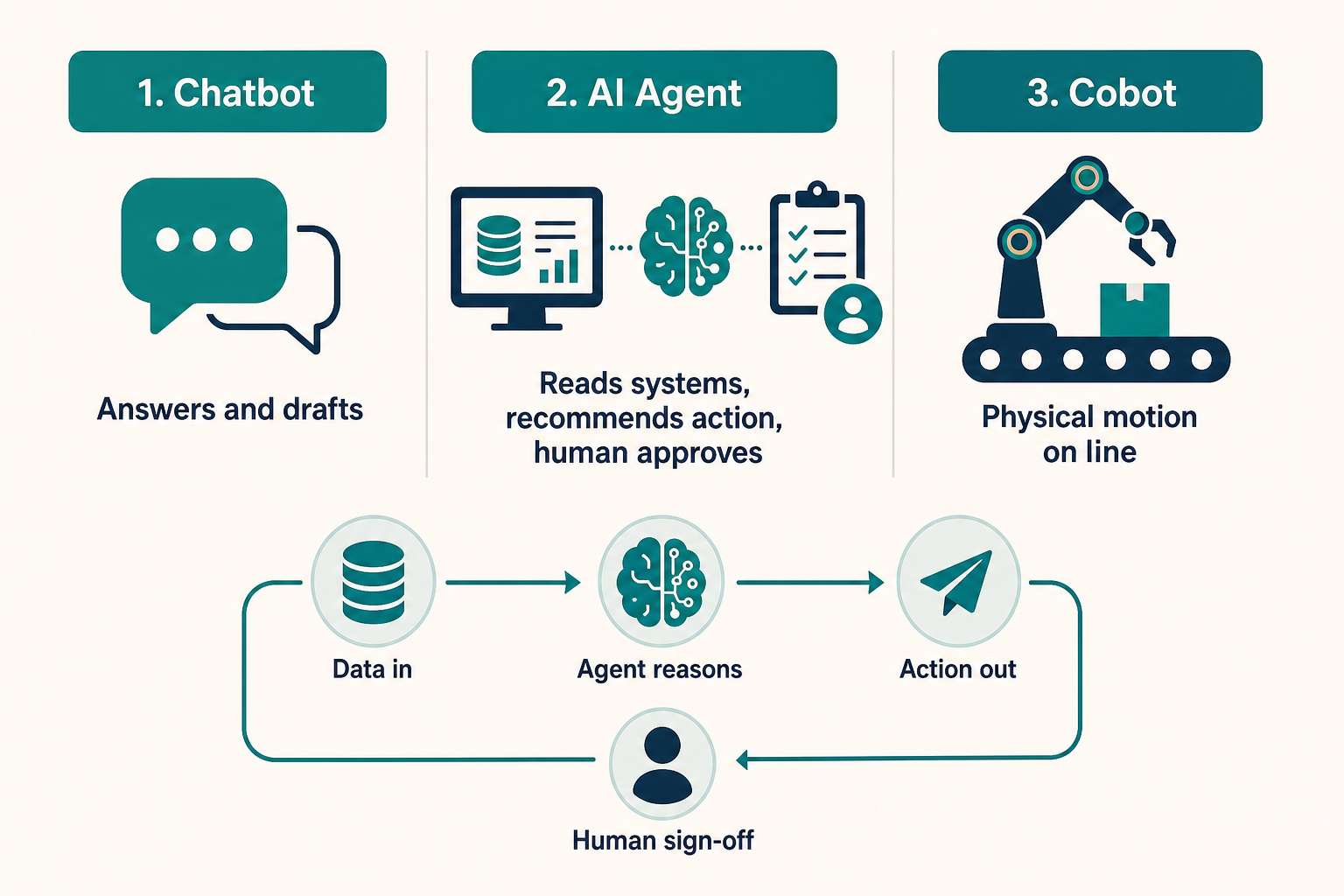
A chatbot answers questions or drafts messages. You still chase the work — follow up with suppliers, close the ticket, update the sheet.
An AI agent goes further: it watches a defined workflow, reads context from your business systems (ERP, maintenance logs, trackers, email), suggests or triggers the next step, keeps status updated, and asks a human for approval when the decision affects money, safety, quality, or production commitments.
A cobot or industrial robot handles physical motion — loading parts, tending a press, packing cartons. It solves a different bottleneck than an agent.
Example: An agent does not replace your maintenance head. It reads open breakdown tickets, checks spare-part availability, flags machines at risk before the morning shift, and sends one ranked action list to the supervisor — instead of three people chasing updates on WhatsApp.
Why Evolve Robot Lab Is Adding SME AI Agents to Our Automation Practice
Evolve Robot Lab built its practice on floor walkthroughs and physical automation — press tending, polishing, packing, and cobot cells across Chennai and Tamil Nadu. On every visit, we see the same pattern: the machine problem is visible, but the bigger delay is coordination — sign-offs, spare parts, batch release, and information scattered across people and systems.
That is why we are adding SME AI agent workflows alongside robotics — not instead of it. For many manufacturers, an agent pilot is lower capex and faster to measure than a full automation cell. If it clears one recurring coordination loop in weeks, you have proof. If the bottleneck is physical, the same walkthrough points to cobots.
This is expansion with high payoff for lean teams: one buyer, one relationship, two layers of automation — coordination first, motion when the ROI is clear. See our cobot automation guide for the physical layer; this article covers the coordination layer.
The Opening Tension: Big Promise, Small Starting Point
MIT Technology Review’s guidance on finding value from AI agents points to a practical reality that many buyers already feel: the excitement is ahead of the operating model. Agentic AI is often described as software that can reason, act, and coordinate with limited human input. In presentations, that becomes autonomous cyber defense, self-healing supply chains, or teams of digital workers handling complex business processes. In the plant, the first useful question is narrower: which recurring delay can an agent reduce this week?
That shift matters. Enterprise technology programs fail when they begin with a capability and search later for a problem. Factory automation has taught the opposite lesson for decades. A robot cell is justified by cycle time, quality, safety, labor availability, or throughput. AI agents should be judged in the same language. If an agent cannot shorten response time, reduce manual follow-up, improve exception handling, or protect uptime, it is still an experiment rather than an operating asset.
Why It Matters Now
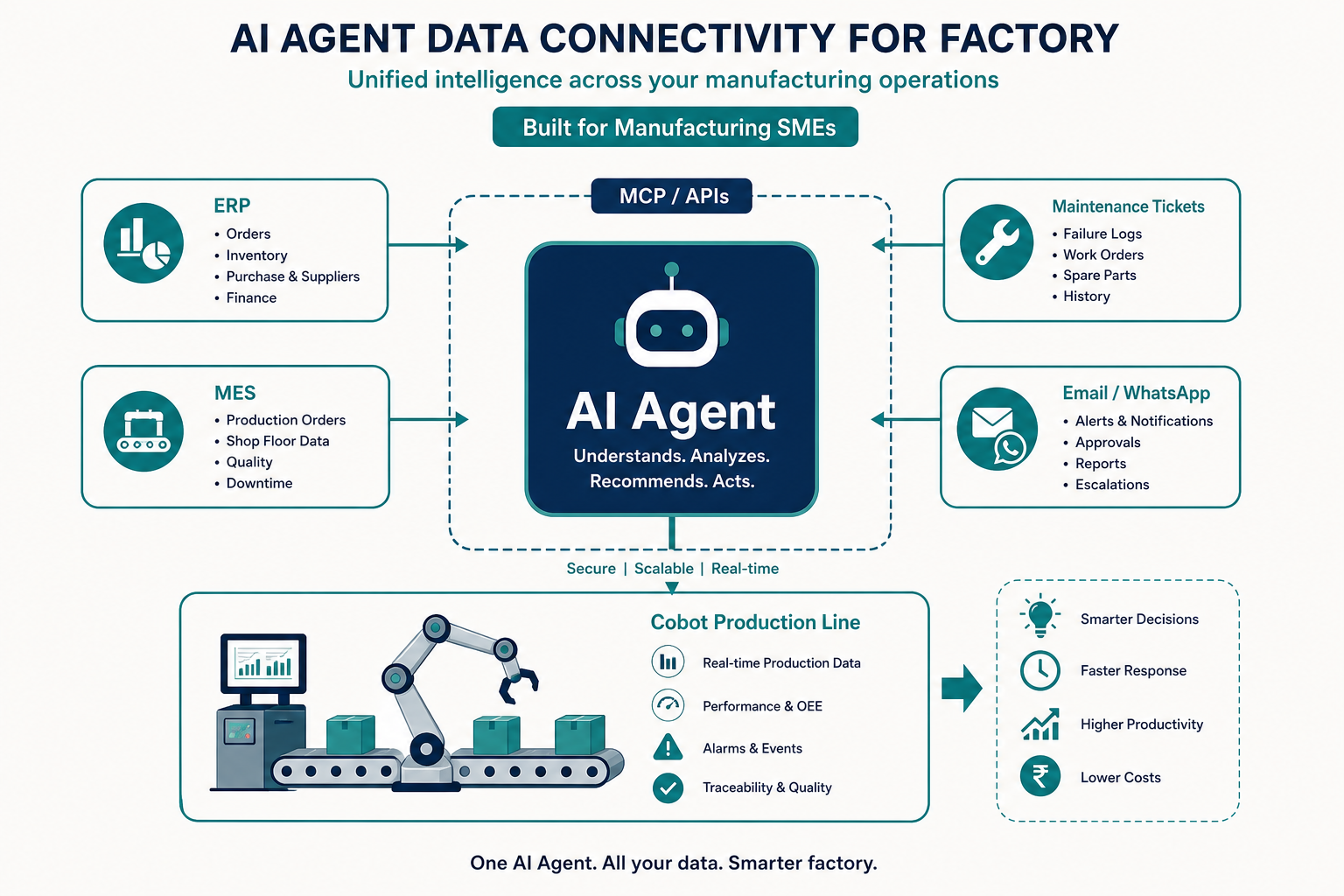
Agentic AI is arriving at the same time operations teams are carrying more coordination load. Production data sits in ERP, MES, spreadsheets, maintenance systems, email, WhatsApp groups, vendor portals, and machine logs. Supervisors do not just manage machines; they reconcile information across systems. A delayed material, a missing quality sign-off, or an unresolved service ticket can leave expensive equipment underused even when the underlying problem is small.
This is why simple agents can matter before fully autonomous systems are mature. A basic reasoning agent with the right context can monitor an exception queue, draft the next action, route it to the responsible person, and keep the record updated. It does not need to replace the planner, maintenance head, or production supervisor. It needs to remove the repeated clerical drag that prevents those people from acting quickly.
The cautionary tale is blockchain. Many companies bought the future-facing narrative before they had a business problem that required the architecture. Agentic AI will face the same risk if buyers start with multi-agent ambition instead of measurable workflow pain. The strongest use cases will feel almost mundane at first: purchase follow-up, service triage, quotation preparation, downtime analysis, inventory exception alerts, customer support routing, and documentation cleanup.
KASS Before Agent Swarms
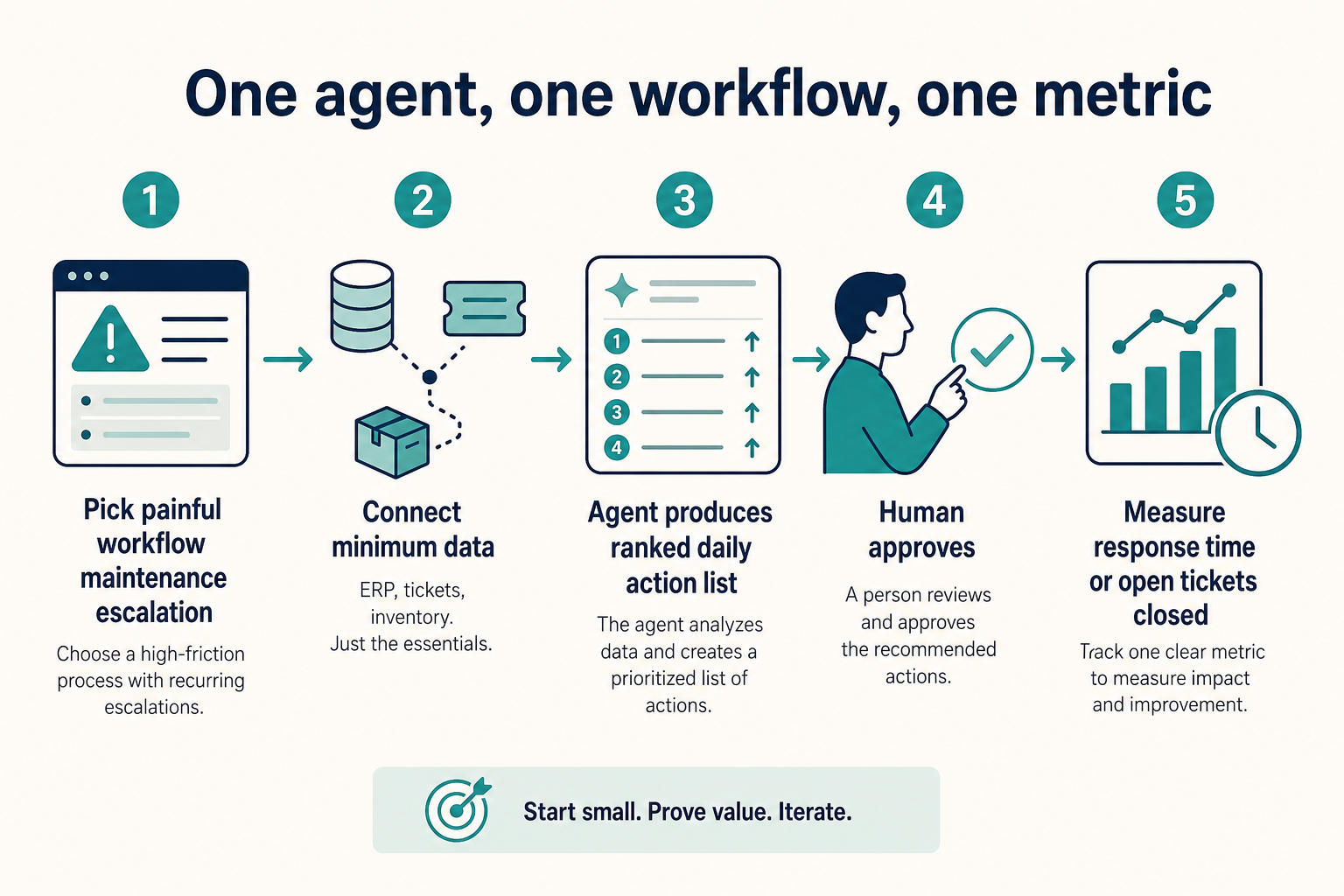
A useful principle for early adoption is KASS: keep agents simple and specific. Start with simple reasoning agents supported by contextual data before attempting large agent swarms. In factory and enterprise settings, that means one agent, one workflow, one accountable owner, and one metric that matters.
For example, a plant could deploy an agent to watch open maintenance requests and match them against spare-part availability, machine criticality, and planned production schedules. The agent’s job is not to run the maintenance department. Its job is to prepare a ranked action list every morning, highlight missing information, and notify the right person when a stoppage risk is rising. That is a bounded task. It can be reviewed. It can be measured. It can improve without becoming dangerous.
The same approach works in sales operations, procurement, service support, and compliance documentation. A week-one agent should behave like a disciplined coordinator: it reads the available context, suggests the next step, records the status, and asks for human approval when the action affects money, customers, safety, or production commitments.
Connect Data Early, Even If The Pilot Is Small
The agent’s intelligence depends less on dramatic autonomy than on useful context. If the system cannot see the purchase order, work order, machine status, customer priority, or escalation history, it will produce polished guesses. This is why data connectivity should begin early, not after the pilot proves popular.
Model Context Protocol, or MCP, is gaining attention because it points toward plug-and-play connectivity between AI systems and the tools where business data lives. APIs serve the same practical purpose when implemented well. For buyers, the technical label matters less than the principle: agents need governed access to the systems that define the work. A factory agent should not depend on someone pasting screenshots into a chat window every morning.
MCP / APIsERP + MESAgent context
This does not mean connecting everything on day one. It means choosing the minimum data path that makes the agent operationally useful. For a maintenance triage agent, that may be machine list, breakdown history, open tickets, spare inventory, and shift schedule. For a quotation agent, it may be product catalog, price rules, customer history, and approval thresholds. Clean boundaries make the agent easier to test, govern, and improve.
AI Agents and Cobots on the Factory Floor

AUBO cobotERL lab cellNot the same as agent software
For manufacturers evaluating robotics, the most productive framing is not agents versus cobots. Physical automation handles motion, precision, repeatability, and safety-rated work at the machine or line level. AI agents coordinate the surrounding information work: planning, exception handling, documentation, scheduling, procurement follow-up, and service communication.
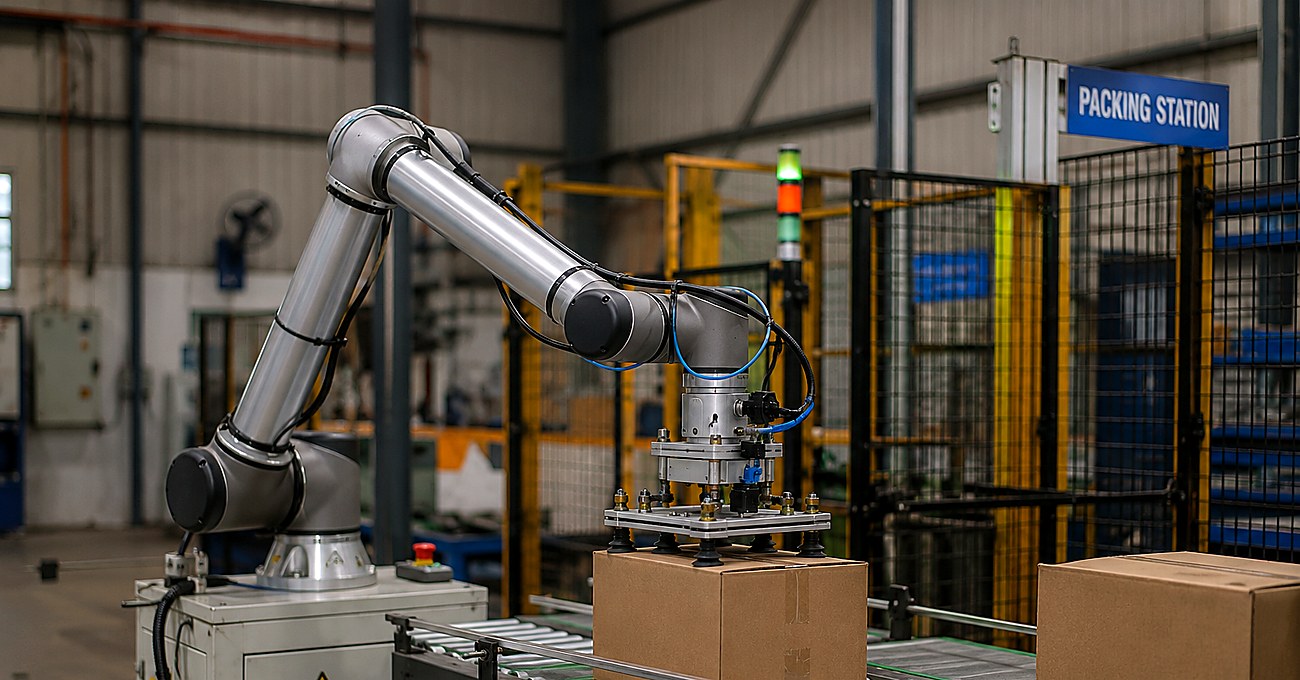
On a recent floor walkthrough at a stainless kitchenware exporter in Chennai’s MEPZ zone, our team mapped three high-friction stations — press tending, polishing, and packing — where machines waited on people, not parts. The cobot pilot targeted physical loading; the supervisor’s bigger daily drag was chasing quality sign-offs and maintenance updates across WhatsApp, email, and a shared spreadsheet. That is exactly the kind of narrow coordination loop a first agent can own while automation handles the motion.
ERL deploymentPacking cellCobots + agents
A cobot can load parts, tend a CNC machine, assist inspection, or support packaging. An agent can watch whether the next batch is released, whether inspection documents are complete, whether maintenance has cleared a recurring fault, and whether the supervisor needs to adjust the job sequence. The payback improves when both layers are designed together. The robot reduces physical bottlenecks. The agent reduces coordination bottlenecks.
This is especially relevant for Indian factories and growing global suppliers where teams often run lean, customer requirements are tightening, and supervisors carry too much informal knowledge in phone calls and spreadsheets. The immediate opportunity is not to make the plant autonomous. It is to make daily execution less dependent on memory, manual chasing, and delayed escalation.
90-day pilotKASSMeasurable ROI
A 90-Day Checklist For The First Agent
- Choose one painful workflow: delayed maintenance closure, quotation turnaround, purchase follow-up, quality documentation, service ticket routing, or production exception escalation.
- Define one business metric: hours saved, downtime avoided, response time reduced, open items closed, rework prevented, or supervisor follow-ups eliminated.
- Start with one simple agent: give it a narrow job, a clear owner, reviewed outputs, and explicit rules for when it must ask for approval.
- Connect only the needed systems: use MCP, APIs, exports, or approved databases so the agent works from current operational context rather than pasted fragments.
- Keep humans in the control loop: require review for customer commitments, financial approvals, safety decisions, production changes, and supplier promises.
- Review weekly: compare the agent’s recommendations with actual outcomes, remove weak prompts, improve data access, and stop any workflow that does not show operating value.
FAQ: Buying AI Agents For Operations
Do we need a multi-agent system to begin? No. Most factories should begin with one narrow agent tied to one workflow. Multi-agent coordination becomes useful only after the individual tasks, data access, and approval rules are stable.
What makes an agent different from a chatbot? See What Is an AI Agent? above — chatbot vs agent vs cobot. In short: if it only drafts text, it is a chatbot; if it follows a workflow using your systems and improves a metric you track, it is an agent.
Where should factories start? Start where manual coordination is visible: maintenance escalation, production planning exceptions, purchase follow-up, service documentation, quotation preparation, or quality closure. These workflows usually have enough repetition to measure value quickly.
Will agents replace robotics or shop-floor automation? No. Agents are better understood as the coordination layer around physical automation. Cobots and machines execute physical work; agents help ensure the right job, data, approval, material, and escalation reach the right person at the right time.
Start With One Agent, One Process, One Metric
The winning agent projects will not be the ones with the grandest autonomy story. They will be the ones that make a supervisor’s morning shorter, a machine’s idle time lower, a customer response faster, or a maintenance decision clearer. Week-one value comes from disciplined scope: simple agents, connected data, measured pain, and human approval where the stakes are high.
Evolve Robot Lab helps manufacturers pair physical automation (cobots, cells, conveyors) with practical AI workflow design — so agents and robots solve the same business problem, not parallel science projects. Book a floor walkthrough →